

preloader

About Us

We must explain to you how all seds this mistakens idea off denouncing pleasures and praising pain was born and I will give you a completed accounts off the system and expound.

Contact Info

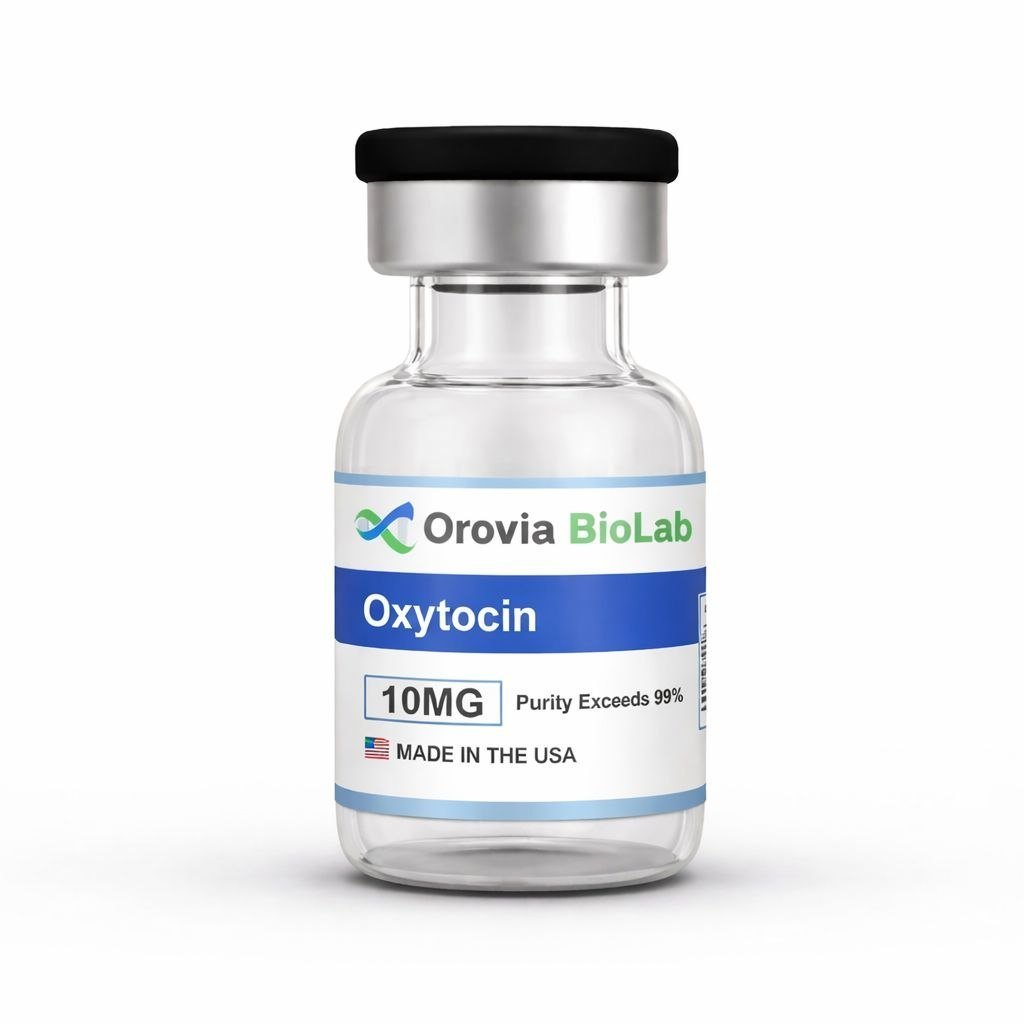
Oxytocin Peptide

Oxytocin Peptide

  • Home
  • -
  • Product
  • -
  • Oxytocin Peptide

Oxytocin Peptide

$45.00

Biosynthesis Pathway

  1. Hypothalamus: Prepro-oxytocin (OT/NP-II precursor, 125 aa) gene (OXT on chr20p13).
  2. Processing: Signal peptide cleaved → pro-oxytocin → enzymatic removal → active OT + neurophysin.
  3. Release: Ca²⁺-triggered exocytosis from pituitary; also peripheral sources (uterus, testes).

Receptors & Signaling

  • OXTR (GPCR): High affinity (Kd ~1 nM); couples to Gq → PLC → IP₃/DAG → Ca²⁺ release.
  • Distribution: Brain (amygdala, nucleus accumbens), uterus, mammary glands.
  • Downstream: MAPK/ERK activation; gene expression changes (e.g., EGR1).
Receptor Location Primary Effect
CNS Social memory, anxiety reduction
Uterus Contractions (via PG F2α synergy)
Heart Cardioprotection (low dose)

Pharmacokinetics

Route Bioavailability Cmax Notes
IV 100% 3–5 min Obstetric use (10–40 IU)
Intranasal 5–10% 20–40 min Brain penetration via olfactory route
SubQ/IM ~50% 10–20 min Research/animal studies
Oral <1% N/A Degraded by GI peptidases
  • Metabolism: ENK/aminopeptidases; renal clearance.
  • Analogs: Carbetocin (longer T½, 1–2 hrs), Atosiban (antagonist).

Advanced Research & Therapeutic Applications

Area Key Findings Status
Autism/ASD Improves social cognition in some trials (24 IU IN). Phase II/III (e.g., NCT01889856)
Depression Augments SSRIs; reduces postpartum blues. Meta-analysis: Moderate effect (Freeman et al.).
Addiction Blocks ethanol preference in rodents. Preclinical
Wound Healing Accelerates via fibroblast migration. Animal models
Cancer OXTR overexpression in breast tumors; potential target. Exploratory
  • Genetics: OXTR polymorphisms (rs53576) linked to empathy/trust variance (meta-GWAS).

Lab Synthesis Protocol (Fmoc-SPPS, ~1 mg scale)

1. Resin: Rink amide (0.1 mmol).
2. Couple Fmoc-Gly-OHFmoc-Leu...Fmoc-Cys(Trt)-Asn.
3. Ioxidation (AcOH/DMF) for S-S bond.
4. Cleavage: TFA/TIS/HO (95:2.5:2.5), 2h.
5. Purification: RP-HPLC (C18, 1050% ACN/0.1% TFA).
6. Yield: 2040%; MS: [M+H]= 1007.5 Da.

Equipment: CS136XT synthesizer; lyophilizer.

Natural Boosters & Measurement

  • Lifestyle: Physical touch, petting dogs (+20–200% spike), music.
  • Assay: ELISA kits (~$300, sensitivity 1 pg/mL); LC-MS for precision.
  • Deficiency: Rare; linked to Prader-Willi syndrome.

Safety & Contraindications

  • Overdose: Uterine hyperstimulation, water intoxication.
  • Interactions: Avoid with vasopressors; potentiates prostaglandins.
  • Legal: Schedule IV in some regions for research peptides.

Fun Fact: Prairie voles’ monogamy tied to high OT receptor density in reward areas—basis for “love at first sight” research.

Sources: Pharmacol Rev (2013), Front Neuroendocrinol (2020), Sigma-Aldrich protocols, ClinicalTrials.gov. Need synthesis files, analogs, or trial data? Ask!

Description

Oxytocin Peptide

Oxytocin is a peptide hormone and neuropeptide consisting of 9 amino acids (molecular formula: C₄₃H₆₆N₁₂O₁₂S₂, molecular weight: ~1,007 Da). It’s produced in the hypothalamus and released by the posterior pituitary gland. Often called the “love hormone” or “cuddle chemical,” it plays key roles in social bonding, reproduction, and stress regulation.

Chemical Structure

Cys-Tyr-Ile-Gln-Asn-Cys-Pro-Leu-Gly-NH
(Disulfide bridge between Cys¹ and Cys⁶)
  • Sequence: Cyclical structure due to the disulfide bond.
  • It’s synthesized as a larger precursor (prepro-oxytocin) and cleaved into the active nonapeptide.

Primary Functions

Function Description Evidence
Social Bonding Promotes trust, empathy, and pair bonding (e.g., mother-infant attachment). Studies show intranasal oxytocin increases eye contact and generosity in trust games (Kosfeld et al., 2005, Nature).
Reproduction Induces uterine contractions during labor; milk ejection in breastfeeding. FDA-approved synthetic analog (Pitocin) used in obstetrics.
Stress & Anxiety Reduces cortisol; enhances relaxation. Meta-analyses link higher oxytocin to lower anxiety in social contexts (e.g., Bartz et al., 2011, Psychoneuroendocrinology).
Other Influences male reproduction (sperm motility), wound healing, and appetite regulation. Rodent studies show knockout mice have impaired social behaviors (Nishimori et al., 1996).

Peptide Synthesis & Research Use

Oxytocin is commonly synthesized via solid-phase peptide synthesis (SPPS) for lab/research purposes:

  1. Fmoc/t-Bu strategy on resin (e.g., Rink amide).
  2. Sequential coupling of protected amino acids.
  3. Cyclization via iodine oxidation for disulfide bond.
  4. Purity: HPLC-purified to >95%; lyophilized powder stored at -20°C.

DIY/Research Dosage (intranasal or subQ, not medical advice):

  • Research: 24–40 IU intranasal sprays.
  • Stability: Refrigerate; half-life ~3–9 min in plasma due to peptidases.

Sources & Availability

  • Pharma-grade: Prescription (Pitocin injection).
  • Research peptides: Vendors like Peptide Sciences or Bachem (~$20–50/mg).
  • Endogenous boost: Hugging, massage, or orgasm naturally spikes levels 3–5x.

Potential Side Effects/Risks

  • High doses: Hyponatremia, hypotension, seizures (rare).
  • Autism/psychiatry trials: Mixed results for social deficits.

For custom synthesis protocols or analogs (e.g., carbetocin), provide more details! Sources: PubChem, UniProt (P23435), Neuroscience & Biobehavioral Reviews.
Reviews

There are no reviews yet.

Be the first to review “Oxytocin Peptide”

Your email address will not be published. Required fields are marked *